
From Ducks to Dreams: Building a Math Arcade with AI, Canva, and Analytical Minds
Updated: Jun 11, 2025
It all started with a simple idea: how to make learning about statistics less… dry. I whipped up a quick game about ducks and statistics, and to my delight, it actually worked! This small success sparked a bigger vision. After a brief conversation and brainstorming session with a colleague, we posed the question: What if we built a Math Arcade? What if our Grade 8 MYP students became the game designers themselves, creating their own math review games?
The vision was clear: empower students to choose topics, craft questions of varying difficulty, and even dream up the game’s story. Imagine Flappy Bird with linear functions, or a block-clearing challenge powered by probability!
From Feedback to Frenzy: The Design Journey Begins with Analytical Thinking
Our initial game was put to the test, and the feedback from students was invaluable. They played, they laughed, and then they gave us their honest thoughts. Armed with their insights, we challenged them to set the criteria for a great game. Clear instructions, multiple levels, engaging visuals – the ideas flowed.
This initial phase was steeped in analytical thinking. Students weren't just brainstorming; they were critically evaluating existing games, dissecting feedback, and logically deconstructing what makes a game both engaging and educational. They were, in essence, becoming junior product managers, analyzing user needs and defining project scope before any creation even began.
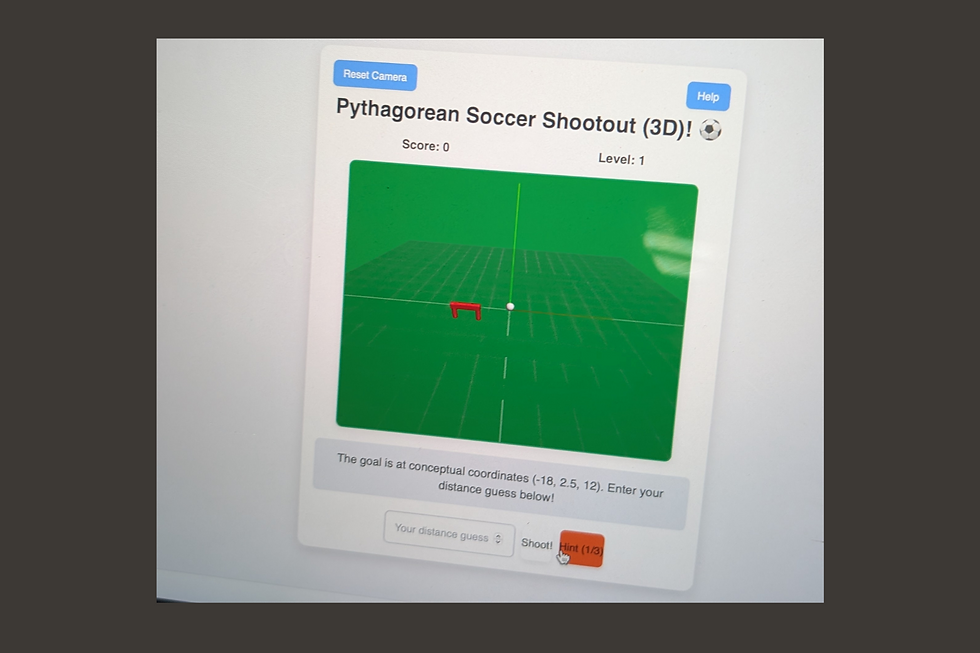
The room buzzed with creative energy. We moved to brainstorming, and the ideas were astounding: algebra-battling emoji animals in a Street Fighter-esque game? Pythagoras-powered 3D football? Cake making with probability? The excitement was electric!
Unleashing the Power of AI: Gemini and Canva as Analytical Accelerators
After this riot of creativity, we introduced the power of AI, specifically Gemini, our creative and analytical partner. We demonstrated how tools could be used to bring their wildest game ideas to life. I showed them a version of an "Algebra Block Blaster" game, where players needed to simplify expressions quickly to clear blocks. The mechanics were intricate: hit a bomb and answer correctly, and it cleared its own square plus eight around it; get it wrong, and the bomb disappeared but blocks remained.
We walked through a series of prompts, showcasing live how Gemini could help design game logic and structure. Students saw firsthand how to prompt AI to ask them questions about their game concept, forcing them to analytically consider game flow, scoring, and user experience even before coding began. This was a crucial step in formalizing their analytical thinking process. They became hooked. "I'm going to make a game like Roblox," they whispered, eyes alight with possibility. Students quickly started down their own paths, envisioning games like "Dress to Impress" (with a mathematical twist, of course!) and a math-infused "Flappy Bird."
The students primarily leveraged Gemini for coding assistance and brainstorming, but a key analytical challenge remained with them: creating the leveled questions themselves. While AI could help embed features, they had to critically design the difficulty progression. They'd use Gemini to troubleshoot and embed features, then, in a beautiful display of collaboration, share their learnings with their friends.
Alongside Gemini, Canva emerged as our visual powerhouse. Students embraced its user-friendly interface and its built-in AI capabilities. They used Canva's image generator to craft unique characters and design captivating background scenery. Canva AI also played a role in generating code snippets for modern-looking game elements, which could be seamlessly embedded into their own sites. This allowed them to rapid-prototype visual concepts, applying analytical thinking to choose aesthetic elements that best communicated their game's mathematical objectives.
Refining the Challenge: The Analytical Loop of Difficulty and Feedback
Of course, challenges arose. But this was where my role shifted from instructor to guide. We problem-solved together, fostering an environment where students learned to refine their visions and overcome technical hurdles. What truly amazed me was how quickly they embraced complex challenges, leveraging Canva and other tools to explore advanced concepts and platforms. This project was a testament to their ability to learn new skills independently and solve complex problems when given the right tools and guidance.
A key requirement for their games was difficulty progression, aligning with our MYP criteria for applying mathematical knowledge and identifying patterns. This was a continuous exercise in analytical thinking. Students had to critically determine what constituted true progression in their mathematical formulas, how to introduce multi-step problems, and how to scale complexity authentically. They meticulously analyzed feedback from playtesting, often reflecting in groups on how to make something work better – or if it worked at all. This analytical reflection guided decisions on whether to enhance a feature using Gemini, or if the limitations of one AI tool meant they needed to pivot to another platform like GitHub for more advanced implementation. They rigorously adhered to a rubric, ensuring their games met all design and mathematical criteria. There were countless instances where they needed to analytically deduce why something wasn't working, often tracing problems back to their initial prompts, or identifying a limitation of the AI tool that necessitated a creative workaround or the use of another tool.
The Spirit of Collaboration: Building a Math Community
Over a series of lessons, students created, tested, and collected feedback. More importantly, they engaged with each other. I watched as one student, who’d figured out a complex feature, patiently walked his friends through the process. Another group, stuck on a design element, found a brilliant solution thanks to a peer's suggestion. Even students who typically shied away from math threw themselves into this project, creating entire fantasy worlds based on algebra questions. Their pride in their work was palpable.
This project wasn't just confined to our classroom. We collaborated with other teachers within our department, and even members of our Senior Leadership Team witnessed the students' incredible creations. This extended collaboration fostered a school-wide sense of community and shared learning, highlighting the potential for interdisciplinary units (IDU) in the future. Imagine combining math game design with design, digital art, storytelling, or computer science!
The Grand Showcase and Lasting Impact
The culmination was the showcase. Students excitedly shared and played each other's games, a true celebration of their creativity, problem-solving, and hard work. They voted for the best games and teams, recognizing innovation, quality, and depth of questioning.
Post-project, the buzz isn't dying down. Students are still talking about how they could create games for future revision. They're demonstrably more comfortable working together, offering and accepting feedback, recognizing that everyone is working towards a common goal.
Reflections: AI as a Catalyst for Connection, Creativity, and Analytical Growth
This Math Arcade project became far more than just a series of lessons on game design. It was a powerful demonstration of how AI, specifically Gemini and Canva, can serve as tools to bring communities together, both within the classroom and across the school. These AI platforms broke down barriers to creativity, enabling students to realize complex visions that would have been impossible just a few years ago.
This shared creative journey forged new connections. Students learned to articulate their ideas, refine their visions, and troubleshoot collaboratively. They embraced constructive feedback, understanding that it helped them reach their collective "game goal." Crucially, they developed and honed their analytical thinking skills at every turn – from dissecting project requirements and game mechanics, to iterating on design through feedback, to systematically problem-solving technical challenges. They learned to think like designers, developers, and critical users all at once.
From a simple idea, we created a multi-lesson, year-group-wide mathematics project that enhanced creativity, built connections, and taught invaluable new skills in design, technology, and collaboration. It was a powerful reminder that sometimes, the best learning happens when you just let students play. As research consistently shows, gamification isn't just fun; it significantly enhances student engagement and learning.
What incredible ways are you seeing technology foster creativity and connection in your own learning environment?
P.S. The game that sparked it all: Pixelated Data Detectives: The Duck Hunt


Comments